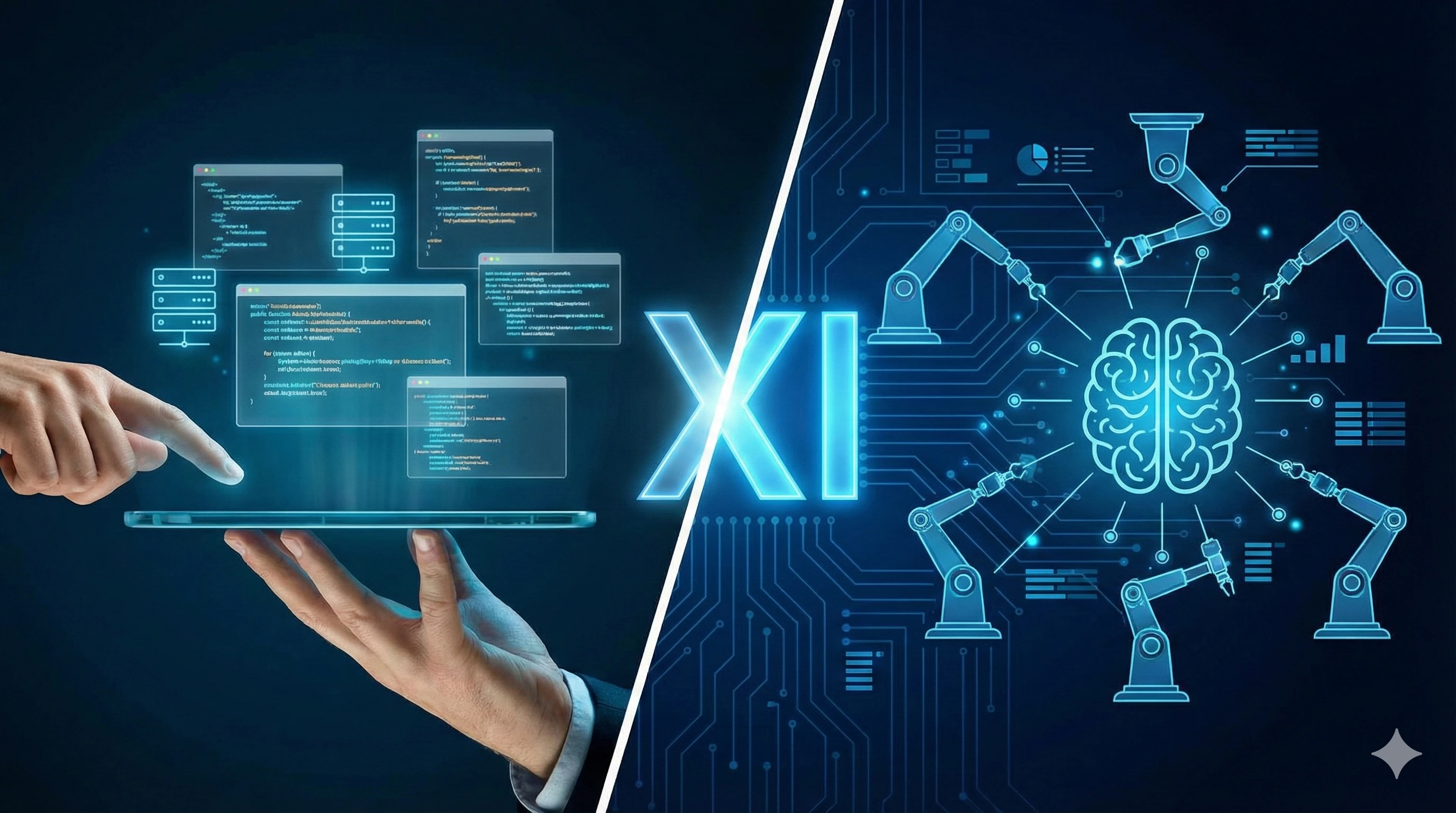
Full-stack development once meant building the frontend, connecting the backend, managing the database, and deploying the application. That definition no longer reflects reality.
In 2026, AI has reshaped how software is designed, developed, optimized, and scaled. Full-stack development is no longer just about writing functional code—it is about engineering intelligent, high-performance systems that adapt and improve over time.
Historically, full-stack developers handled user interfaces, backend logic, databases, and basic infrastructure.
Success was measured by features delivered, functionality completed, and speed of deployment. Performance, intelligence, and long-term scalability were often secondary considerations.
As digital systems grew more complex and competitive pressures increased, that model became insufficient.
AI has not replaced full-stack developers. It has expanded their responsibilities.
Modern full-stack development now includes AI-assisted coding, intelligent backend logic, automation-first architecture, scalable cloud infrastructure, and continuous performance optimization.
The role has evolved from code implementation to system architecture and integration.
AI-powered tools now generate boilerplate code, suggest improvements, detect bugs, and accelerate testing.
This increases development speed but raises the bar for architectural judgment, security oversight, and performance awareness.
Developers must review AI-generated output carefully and design systems that remain stable and secure at scale.
Backends are no longer static rule engines.
AI-enabled systems personalize experiences, predict user behavior, optimize workflows, and automate decisions based on real-time data.
This requires developers to think beyond CRUD operations and design context-aware systems.
Automation is now embedded within full-stack development.
Modern applications integrate workflow automation, event-driven architecture, third-party orchestration, and no-code or low-code platforms.
Developers design systems that operate continuously with minimal manual intervention.
AI-driven products have raised user expectations. Instant responses, seamless interfaces, and high availability are standard.
Full-stack developers must prioritize frontend optimization, efficient APIs, caching strategies, scalable infrastructure, and observability.
Performance directly affects user retention, conversion rates, SEO visibility, and revenue growth.
AI systems depend heavily on data.
Full-stack development now involves data pipelines, analytics integrations, real-time processing, and model interaction layers.
Developers must ensure data quality, secure handling, and reliable flows across systems.
AI introduces new risks such as data leakage, unauthorized access, and regulatory challenges.
Modern full-stack systems must integrate secure data handling, role-based access control, audit trails, and compliance by design.
Security is an embedded responsibility—not a separate phase.
Today’s teams often combine full-stack developers, AI specialists, DevOps engineers, and product strategists.
Full-stack developers frequently act as the integration layer, ensuring that systems function cohesively across technologies.
The role has become broader and more strategic.
Development roadmaps are no longer feature-centric.
Performance optimization, automation opportunities, intelligent system enhancements, and scalable infrastructure now receive equal or greater priority.
Features are evaluated based on measurable business impact.
Key competencies now include system architecture design, API and integration expertise, performance optimization, automation strategy, data literacy, and AI capability integration.
The emphasis is on understanding system behavior rather than mastering every individual framework.
Businesses benefit from faster development cycles, smarter products, improved operational efficiency, enhanced user experience, and stronger competitive positioning.
However, these benefits require alignment between engineering decisions and business objectives.
KentaurX builds performance-driven, AI-enabled, and automation-first systems.
Our development strategy integrates scalable architecture, secure infrastructure, intelligent backend systems, and continuous optimization aligned with growth metrics.
The goal is not just functional software—but systems engineered for measurable impact.
Explore full-stack development solutions at KentaurX
No. AI enhances productivity and expands the scope of the role rather than replacing it.
Most developers focus on integrating and applying AI models rather than training them from scratch.
No. They complement development workflows and accelerate execution.
It has become broader and more strategic, requiring systems thinking rather than only coding expertise.
No. Any organization building digital systems is affected by AI-driven transformation.
Full-stack development has evolved from feature implementation to system engineering.
In the age of AI, the stack is larger, the responsibilities are greater, and the business impact is stronger.
The teams that succeed are those who design intelligent, scalable systems aligned with real-world performance outcomes.


Whatsapp: +91 93618 97364
Email: We@kentaurx.com