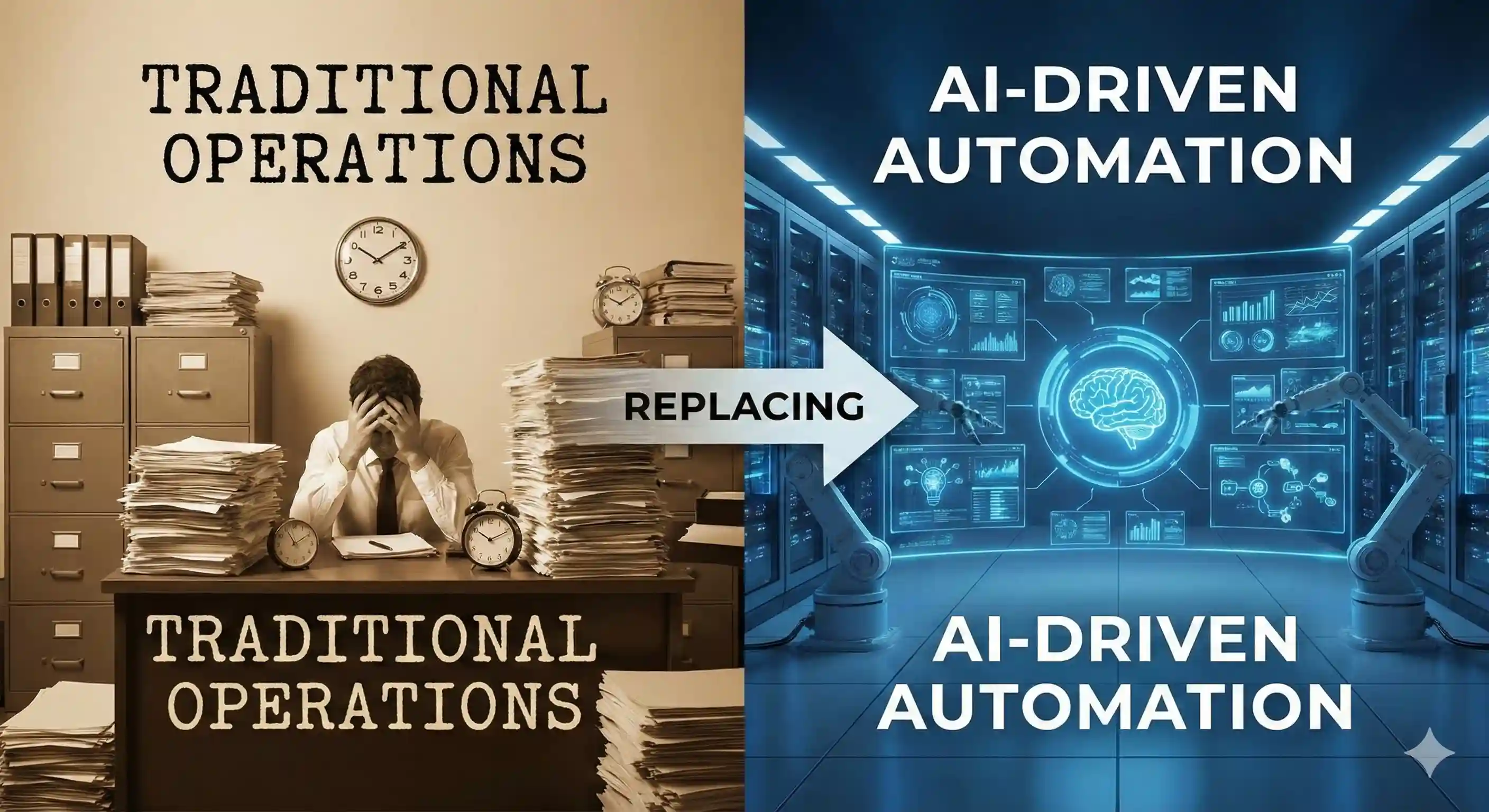
Not long ago, business operations relied on spreadsheets, long email threads, manual approvals, and repetitive data entry. Teams scaled by hiring more people and adding more processes. That model no longer works.
Modern markets move in real time. Customers expect instant responses. Data volumes grow daily. Margins are tighter. Manual operations cannot keep pace.
AI-driven automation is replacing inefficiency with intelligent systems. In 2026, competitive businesses are using AI to automate workflows, eliminate bottlenecks, and make faster, data-driven decisions across departments.
Traditional operations were built around human-led decisions, manual processing, static workflows, and reactive problem-solving.
Today’s businesses face higher transaction volumes, global teams, always-on customers, complex technology stacks, and increasing operational pressure.
The result is operational drag—bottlenecks, errors, slow response times, rising costs, and employee burnout.
AI-driven automation directly addresses these limitations.
Basic automation follows fixed rules: if something happens, perform a predefined action.
AI-driven automation goes further. It interprets data, predicts outcomes, and selects optimal actions dynamically.
It combines machine learning, natural language processing, predictive analytics, and intelligent decision engines. These systems learn and improve over time, adapting to changing business conditions.
Manual workflows create delays and inefficiencies. AI replaces email-based approvals, spreadsheet tracking, and manual task routing with intelligent workflow orchestration.
Automated decision routing, real-time alerts, and process optimization reduce errors and accelerate execution. Operations teams shift from managing tasks to improving strategy.
Traditional support models depend heavily on agents handling repetitive queries.
AI-powered systems resolve common questions instantly, route complex cases intelligently, and predict customer needs before escalation.
This reduces response times, lowers costs, and improves satisfaction while allowing human agents to focus on high-value interactions.
Manual lead assignment and inconsistent follow-ups limit sales performance.
AI-driven automation scores leads based on behavior and intent, triggers personalized engagement, and synchronizes data across CRM and marketing platforms.
Sales operations become structured, predictable, and scalable.
Manual reconciliation and reporting consume significant resources.
AI systems automatically categorize transactions, detect anomalies, forecast cash flow, and flag risk patterns.
Finance teams move from reactive reporting to proactive decision-making.
Traditional HR workflows involve paperwork and slow review cycles.
AI automates resume screening, candidate matching, onboarding processes, and performance insights.
HR teams focus more on talent strategy and employee experience rather than administrative tasks.
Manual supply chain planning struggles with volatility and demand fluctuations.
AI-driven systems predict demand, optimize inventory levels, adjust pricing dynamically, and detect disruptions early.
Operations shift from reactive adjustments to predictive planning.
Traditional operations are reactive, manual, error-prone, and difficult to scale.
AI-driven operations are predictive, automated, consistent, scalable, and data-driven.
AI systems operate continuously without fatigue, reduce human error, and maintain performance as volume increases.
AI replaces repetitive tasks, not strategic thinking. Teams become more productive and focused on higher-value work.
Small and mid-sized companies often benefit significantly because automation enables scale without large hiring increases.
With structured planning and expert integration, automation systems can be deployed efficiently and deliver measurable impact quickly.
Businesses implementing AI automation commonly experience reduced operational costs, faster execution cycles, improved customer experiences, better decision accuracy, and increased employee satisfaction.
The value extends beyond cost savings. Automation creates operational leverage and long-term strategic advantage.
If your organization faces bottlenecks, rising costs, manual reporting, slow response times, or scaling challenges, AI-driven automation is not optional—it is necessary.
Digital transformation is not about adopting new tools. It is about building connected systems.
AI automation connects departments, removes silos, aligns operations with business objectives, and enables real-time execution.
Organizations evolve from disconnected workflows into intelligent operating systems.
KentaurX designs AI-driven automation systems focused on operational performance.
We analyze existing workflows, identify inefficiencies, architect intelligent automation aligned with business goals, integrate across platforms, and continuously measure results.
The objective is not automation for its own sake—but measurable operational improvement.
Explore AI automation solutions by KentaurX
Compared to ongoing operational inefficiencies, automation often delivers return on investment within months.
Yes. Effective AI systems are customized to align with specific operational requirements.
Structured data improves outcomes, but AI systems can also enhance data quality over time.
Implementation timelines vary, but many automation systems can be operational within weeks.
When properly implemented, automation enhances security through monitoring, reduced manual errors, and controlled access systems.
Traditional operations were built for a slower era. AI-driven automation is built for speed, scale, and complexity.
Businesses that adopt intelligent systems gain operational agility and sustainable growth. AI-driven automation does not replace companies—it replaces inefficiency and unlocks performance at scale.


Whatsapp: +91 93618 97364
Email: We@kentaurx.com