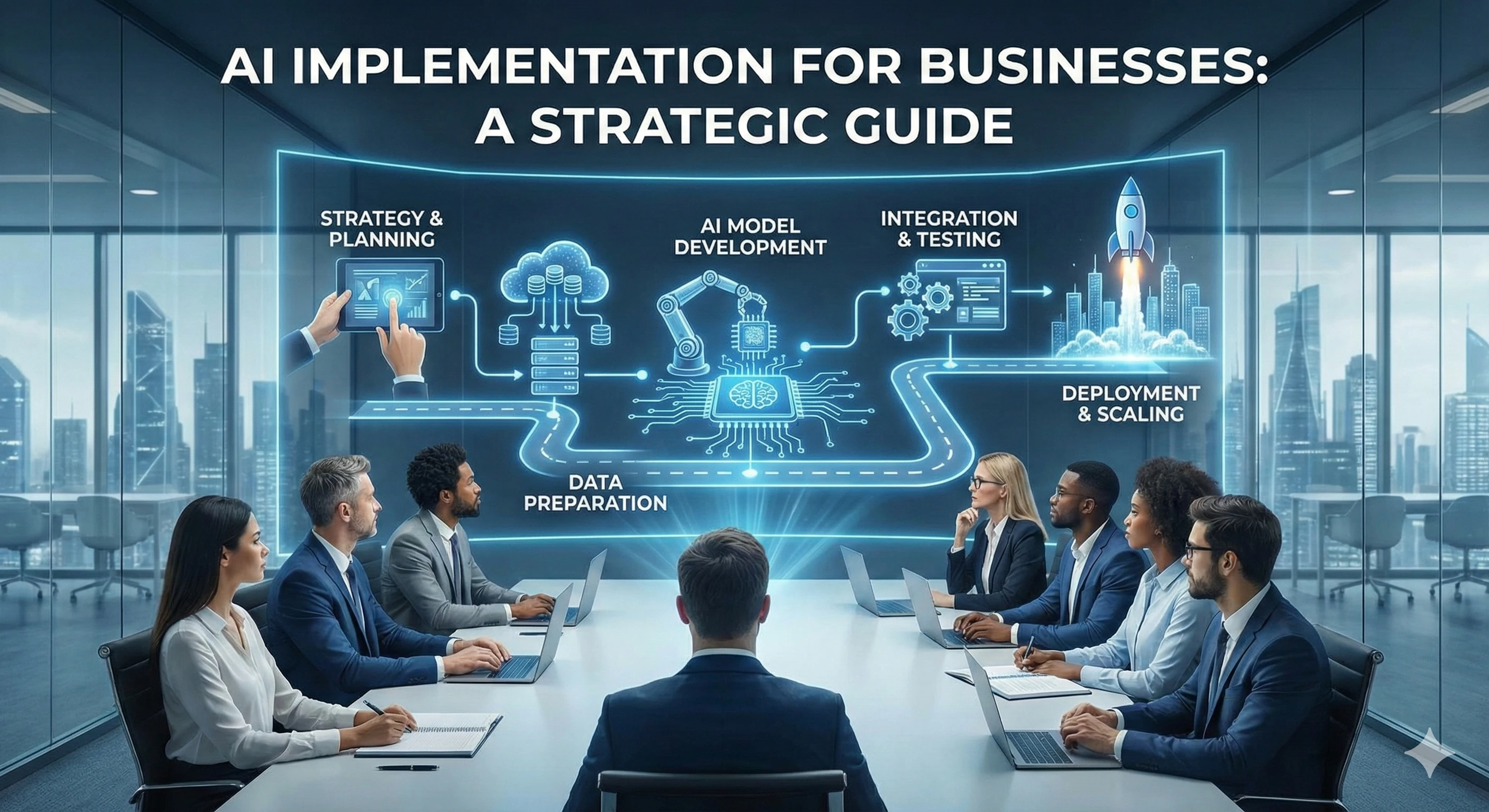
AI is no longer experimental, optional, or limited to large technology companies. In 2026, it is a strategic capability that shapes how businesses operate, compete, and grow.
Yet many AI initiatives fail to deliver meaningful value. The issue is rarely the technology itself. The problem is poor execution, unclear objectives, weak data foundations, and lack of integration.
Successful AI implementation is not about hype. It is about structured execution aligned with measurable business outcomes.
AI projects commonly fail due to unclear objectives, fragmented data, isolated pilots, overreliance on tools instead of systems, and weak internal adoption.
AI is not a plug-and-play solution. It must be embedded into workflows, decision-making processes, and operational systems.
The wrong starting point is choosing a tool. The correct starting point is identifying a business problem.
Strong AI initiatives focus on measurable goals such as revenue growth, cost reduction, operational efficiency, improved decision quality, or enhanced customer experience.
Examples include slow lead response times, manual forecasting, high support volumes, inefficient operations, or limited performance visibility.
AI works best when it addresses a defined and measurable challenge.
Early AI wins should focus on areas with high volume, repetitive decisions, measurable outcomes, and clear ROI potential.
Common early use cases include lead scoring and routing, customer support automation, demand forecasting, fraud detection, anomaly identification, and personalization systems.
Early success builds confidence and organizational momentum.
AI amplifies systems—it does not repair broken ones.
Before implementation, workflows should be mapped, unnecessary steps removed, responsibilities clarified, and success metrics defined.
Automation provides structure. AI enhances intelligence.
AI performance depends on data quality, consistency, accessibility, governance, and security.
While data does not need to be perfect, businesses must establish ownership, reliable pipelines, and clear sources of truth.
Without structured data foundations, AI initiatives struggle to scale.
The AI marketplace is crowded with tools driven by trends and marketing claims.
Technology decisions should be based on workflow compatibility, integration capabilities, scalability, explainability, and long-term cost considerations.
In many cases, tailored AI systems aligned with business processes outperform generic off-the-shelf solutions.
AI must be tied to measurable value creation.
AI must integrate across departments to deliver sustained impact.
Teams need clarity, training, and trust to adopt AI systems effectively.
Gradual expansion reduces risk and builds confidence.
AI requires continuous monitoring, refinement, and optimization.
AI delivers real impact when integrated with CRM systems, ERP platforms, marketing automation tools, support systems, and analytics platforms.
Insights must flow directly into workflows so teams can act without friction.
Scaling AI involves expanding impact, not simply deploying more models.
A structured approach includes starting with one high-value use case, proving results, embedding automation, expanding to adjacent processes, and gradually increasing decision autonomy.
This controlled scaling approach maximizes learning and minimizes risk.
At scale, AI becomes a decision-support layer across departments, a predictive engine for operations, a personalization driver for customers, a cost-optimization system, and a growth accelerator.
The organization transitions from reactive management to proactive intelligence.
AI adoption requires executive alignment, cross-team collaboration, defined ownership, and continuous performance measurement.
It reshapes how decisions are made, making it a strategic transformation rather than a technical upgrade.
Well-executed AI enables businesses to scale without proportional hiring, reduce operational risk, improve margins, respond quickly to market changes, and build sustainable competitive advantages.
AI strengthens strategy—it does not replace it.
KentaurX begins with business outcomes rather than tools.
The process includes identifying high-impact opportunities, designing AI systems aligned with real workflows, integrating intelligence into operations, ensuring scalability and security, and continuously optimizing performance using defined KPIs.
The objective is measurable and sustainable business performance.
Explore AI implementation services by KentaurX
Not always, but many gain significant advantages through targeted automation and intelligent decision systems.
Initial use cases can often be deployed within weeks, with scaling occurring progressively.
Strategic AI initiatives typically generate return on investment quickly when aligned with measurable outcomes.
Many organizations partner externally for implementation and develop internal capabilities over time.
With proper governance, monitoring, and system design, AI implementations can enhance security and reduce risk.
AI is not a shortcut—it is leverage.
Businesses that succeed with AI execute deliberately. They define the right problems, avoid common pitfalls, integrate intelligently, and scale with intention.
The critical question is not whether to adopt AI, but how to implement it strategically for long-term impact.


Whatsapp: +91 93618 97364
Email: We@kentaurx.com